
Project 2
DESIGN PRINCIPLES
Project 2 is designed as a continuation from Project 1 to introduce and identify the design principles of architecture and design in utilizing and creating order in an architectural composition and spatial arrangement. Order refers not simply to geometric regularity, but rather to a condition in which each part of a whole is properly disposed with reference to other parts and to its purpose so as to produce a harmonious arrangement.

REQUIREMENTS
PART 1 – 8 DESIGN PRINCIPLES
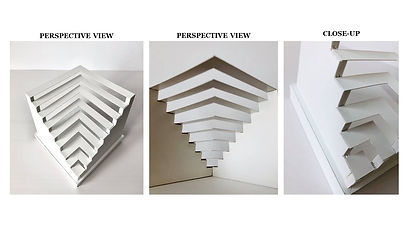
1. Students are required to produce a series of 8 smaller models of 10cm x 10 cm x 10cm each to apply the understanding of design principles. The design principles are BALANCE, RHYTHM, EMPHASIS, MOVEMENT, VARIETY, CONTRAST, HARMONY, and UNITY.
PART 2 – FINAL HYBRID MODEL
1. Upon completion of the series, students are then to combine different design principles to produce a 20cm x 20cm x 20cm HYBRID FINAL MODEL to explore various volumetric of form and space.
2. To produce a minimum of 2 working models or mock-up models before finalizing 1 final model.
PROJECT SHOWCASE
Kindly click on the PDF icon to view the entire slides =)




REFLECTION
It is one of the most time-consuming and mind-twisting project for this semester.
One of the challenges I faced is I was having a tight-schedule to get this project done. This projects require us to produce 8 small models and 1 hybrid final model, so I tried to finish all the small models in the first two weeks ,and the remaining time focus on the final model. The materials are also an issue because we could not go out to buy materials. To deal with this issue, I have bought a number of modelling boards and card boards from Shopee before I start making the final model. The remaining materials are not wasted since there is one more upcoming project.
Although I have submitted the project right on time, I think this is not the best results. However, due to the time limitation and some unforeseen circumstances (frequently blackouts in my house), I had given my very best.
In this project, I have learnt how to apply my understanding of the design principles into models making and also the techniques to manipulate shapes and forms. Furthermore, I learnt that I should be more aware of the time limitation, and always be prepared to face the unforeseen circumstances. I am grateful to have the advices from Mr. Paul and Ms. Hanim to help me improve my models.