
Typographic Systems

"All design is based on a structural system." The typographic systems are similar that the systems has a set of rules that is unique and provides a sense of purpose that directs the decision making.
There are 8 major variations:
a) Axial System: All elements are organised to the left or right of a single axis.

b) Radial System: All elements are extended from a point of focus.

c) Dilatational System: All elements expand from a central point in a circular fashion.

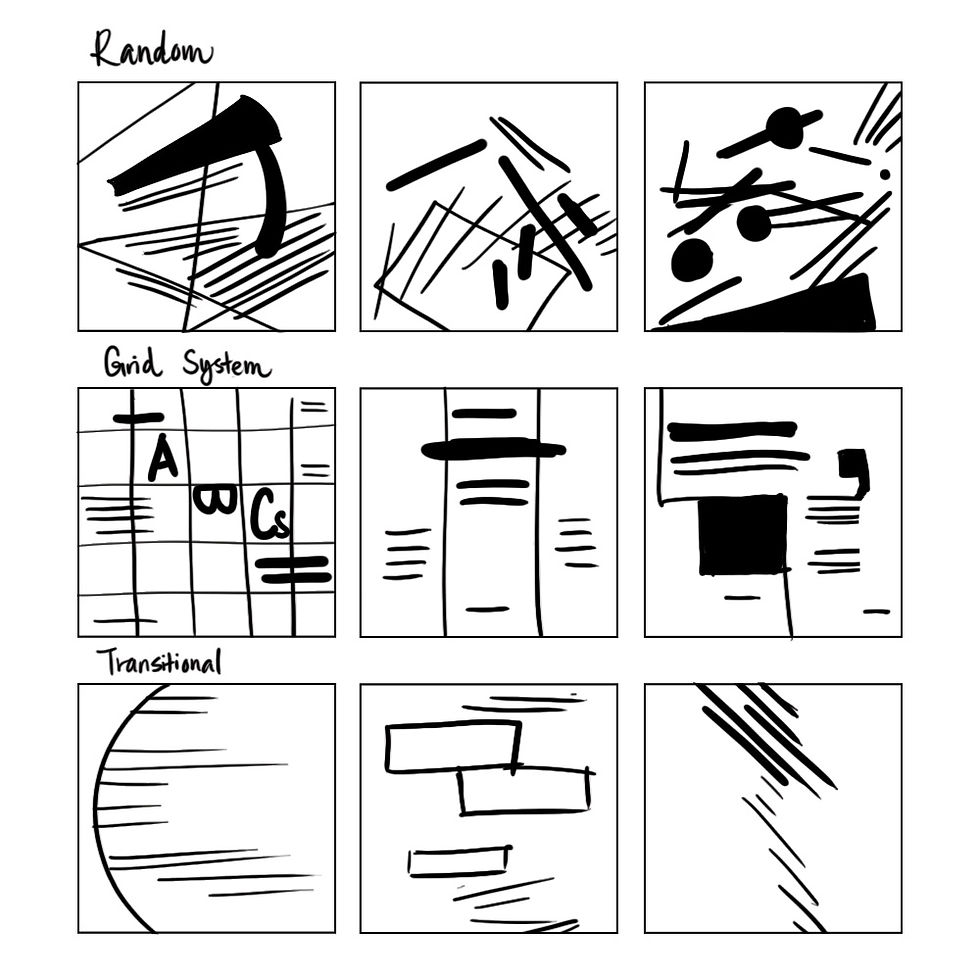
d) Random System: Elements appear to have no specific pattern or relationship.
- Hold people's interest
- There is a method in the chaos

e) Grid System: A system of vertical and horizontal divisions.

f) Transitional System: An informal system of layered banding.

g) Modular System: A series of non-objective elements that are constructed in as a standardised units.
- Allows you to move the individual units to different portions.

h) Bilateral System: All text is arranged symmetrically on a single axis.

In this exercise, students are tasked to explore 8 types of systems using a given content. One extra colour can be picked other than black. Graphical elements like line and dot can be used but limitedly.
Sketch


Axial
This is the axial design progression. The last attempt has a clearer axis and the elements are arranged at left and right.

Radial
The elements are extended from a circle at the left corner.

Dilatational
This is one of the hardest systems to construct, but the efforts paid off.

Random
The second attempt are more eye-catching than the first attempt.

Transitional
The image below shows a few variations of transitional system.

Grid
Grid system may look easy but it took me way too much time to figure out a better layout.

Modular
The tight leading and the alignment are fixed in the second attempt.

Bilateral
Although the first design is symmetrical, the "clumps" of information does not seem to be connected. I then redesigned the title, repositioned the information and added leading lines.

Final Typographic Systems


Comments